

THE SCIENCE
YOUR hair's most vulnerable moment. finally protected.
Why Wet hair is different
Your hair is built for resilience. Dry, healthy hair can stretch significantly before it breaks. The keratin proteins that make up the cortex are designed to absorb stress and recover. But the moment water touches your hair, the chemistry changes.
Water breaks the temporary hydrogen bonds within the keratin structure, and the hair shaft swells. In that state your hair behaves like a different material: far more extensible, far less stiff, stretching under tension it would shrug off when dry. Wet hair can be pulled to roughly 30% beyond its original length before the change stops being reversible. Past that point it does not spring back. That is not resilience. That is damage in progress, and it happens before you pick up a single styling tool.
There is a term in hair science for what happens when this cycle repeats: hygral fatigue. Repeated swelling and drying weakens the hair fiber over time, contributing to porosity, brittleness, and breakage that no product can fully reverse. The vulnerability window, the 10–20 minutes after your shower, is one of the highest-risk moments in your entire hair care routine.
The Problem with Regular Towels
What your towel is actually doing
Think of your hair’s outer layer, the cuticle, as roof shingles lying flat and smooth. When they’re flat, light reflects uniformly, hair looks shiny, moisture stays locked inside, and the fiber is protected. When they’re lifted or chipped, hair looks dull and frizzy, moisture escapes, and the cortex is exposed to damage.
Terry cloth towels are made from large, looped cotton fibers. Their construction is deliberately rough, designed to be abrasive enough to scrub your body. When these loops contact the open, vulnerable cuticle of wet hair, they catch. They lift the scales. They chip them. They create friction that builds with every pass, every scrunch, every towel-dry.
This isn’t dramatic damage. You won’t see it happen. But it accumulates across every wash day, quietly contributing to the frizz, breakage, and split ends that no shampoo or serum was ever designed to fix.
Eliminate Friction. that's the whole idea.
How The GWEN Hair Towel Works
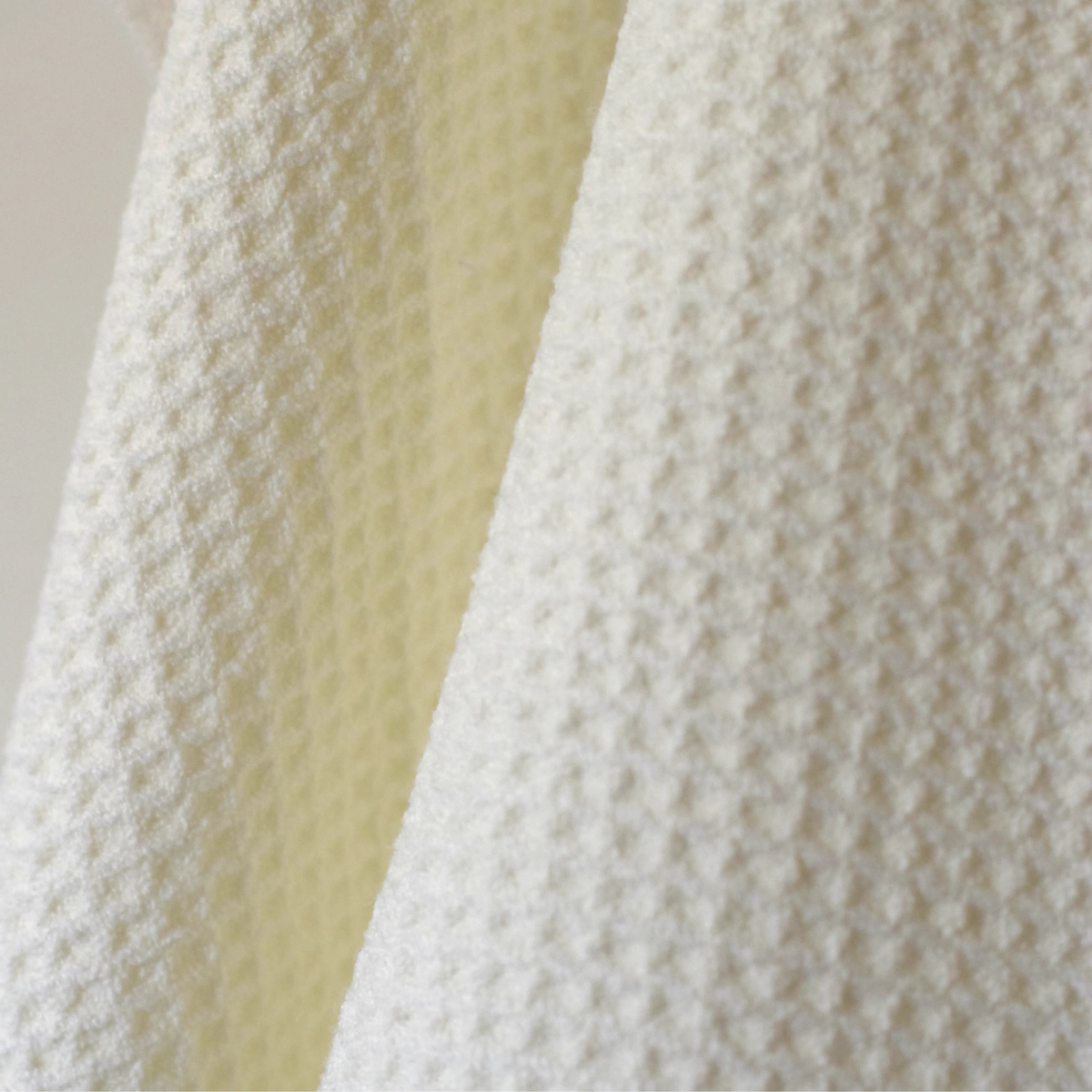
GWEN’s hair towel is built from professional-grade waffle weave microfiber, fibers engineered to measure a fraction of the diameter of a single human hair strand. The result is a surface so smooth it glides over your hair. There are no loops to snag cuticle scales. No abrasive texture. No mechanical stress.
There’s a tangible side effect of this fiber construction worth noting: that same extraordinary fineness that makes GWEN’s surface safe for your cuticle makes the towel remarkably soft to the touch. The suede edge carries that quality all the way through to the finish. Pick up a GWEN hair towel before you’ve read a single word about how it works, and it already tells you something.
Rather than dragging moisture out through friction, GWEN’s waffle weave wicks water through capillary action; the same physics that draws water upward through a paper towel. The channels in the weave create surface area that maximizes absorption without requiring any movement of the towel against the hair. You wrap. You wait. Your hair moves from saturated to damp, in roughly 10–20 minutes, without the heavy friction.
The suede edge is not decorative. It prevents the fraying that develops in cheaper microfiber wraps after a few washes, and the rough edges that fraying creates, which undo everything the microfiber was designed to protect. Every detail on this towel is there for a reason. And it’s also beautiful.
Gavazzoni Dias MFR, "Hair Cosmetics: An Overview," International Journal of Trichology, 2015