
How to Dry Curly Hair Without Disturbing Your Curl Pattern
If you have curly hair, you already know that drying isn't neutral. It's either helping your curls or hurting them. The wrong approach, too much friction, too much disruption, too much too fast, and you end up with a frizzy halo where your curl pattern used to be. The right approach lets your curls dry with their shape intact.
The difference between those two outcomes often comes down to one thing: what you reach for right after you step out of the shower.
Why Curly Hair Responds Differently to Drying
Curly hair has a distinct structure. The curl shape isn't just a surface characteristic, it reflects an asymmetry in the hair shaft itself, including how the cortex is arranged and how the cuticle sits. This architecture makes curly hair naturally more porous than straight hair, with a cuticle that tends to be more lifted and more susceptible to friction and humidity.
When curly hair is wet, it's at a delicate inflection point. The curl pattern wants to form as water evaporates. Any significant disruption during this process, rubbing, roughing up the cuticle, stretching the strand out of its natural formation, interrupts the pattern and causes frizz.
This is why technique matters so much in curly hair care. You're not fighting your hair; you're creating the conditions for it to do what it naturally wants to do.
The Problem With Terry Cloth on Curly Hair
For straight hair, a rough towel mostly creates friction and frizz. For curly hair, it does that and more. It physically disrupts the curl as it's trying to form. The looped terry cloth surface catches and separates strands, roughs up the cuticle, introduces static, and applies pressure that pushes the emerging curl in multiple directions at once.
The result is dried-in frizz that no amount of serum applied afterward can fully fix. Once the curl has dried in a disrupted pattern, it's set.
The Case for Microfiber in Curly Hair Care
Microfiber has been a staple in the curly hair community for a specific reason: its smooth surface creates minimal friction. The split-filament construction draws water away from the strand without the dragging motion that disrupts curl formation.
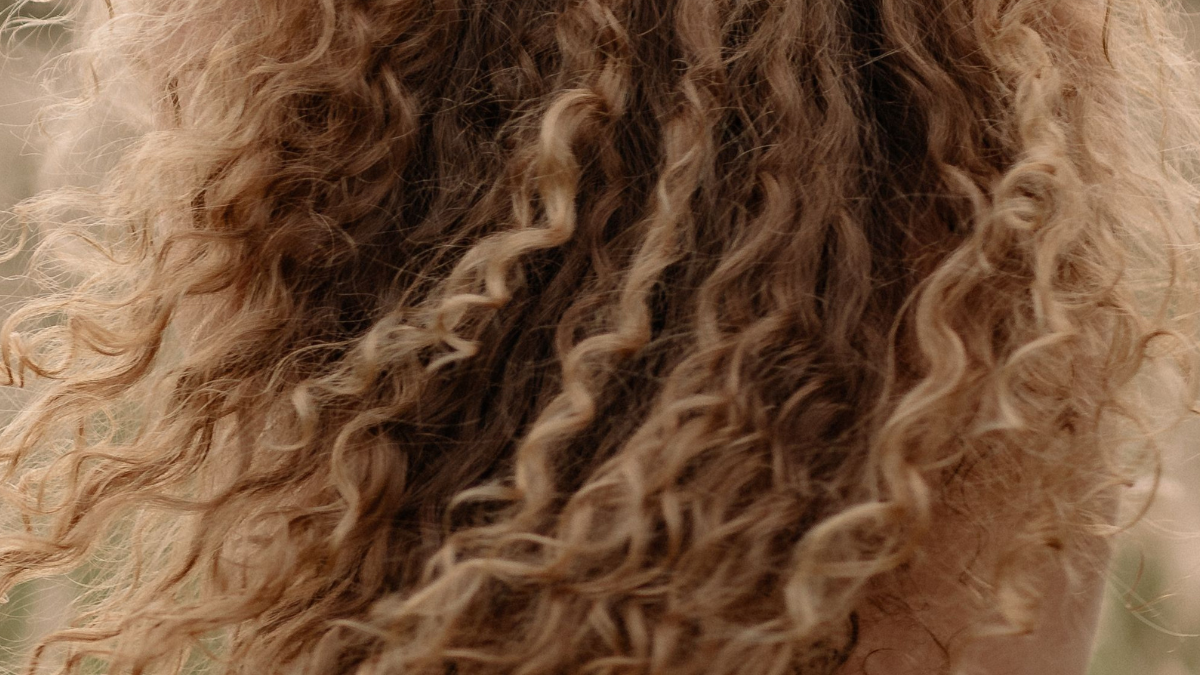
Used correctly, microfiber helps curls retain their clumped formation as they dry. The groups of strands that dry together are the basis of defined, bouncy curls. When friction breaks those clumps apart, you lose definition. When friction is reduced, the clumps stay intact longer.
The Plopping Technique
In the curly hair community, a technique called plopping has become one of the most widely shared methods for improving curl definition. Here's how it works with a microfiber towel:
- After washing and conditioning, apply leave-in conditioner and curl-defining products while your hair is still saturated.
- Lay a flat microfiber towel on a flat surface. The bathroom counter works well.
- Flip your hair forward so all your curls fall toward the center of the towel.
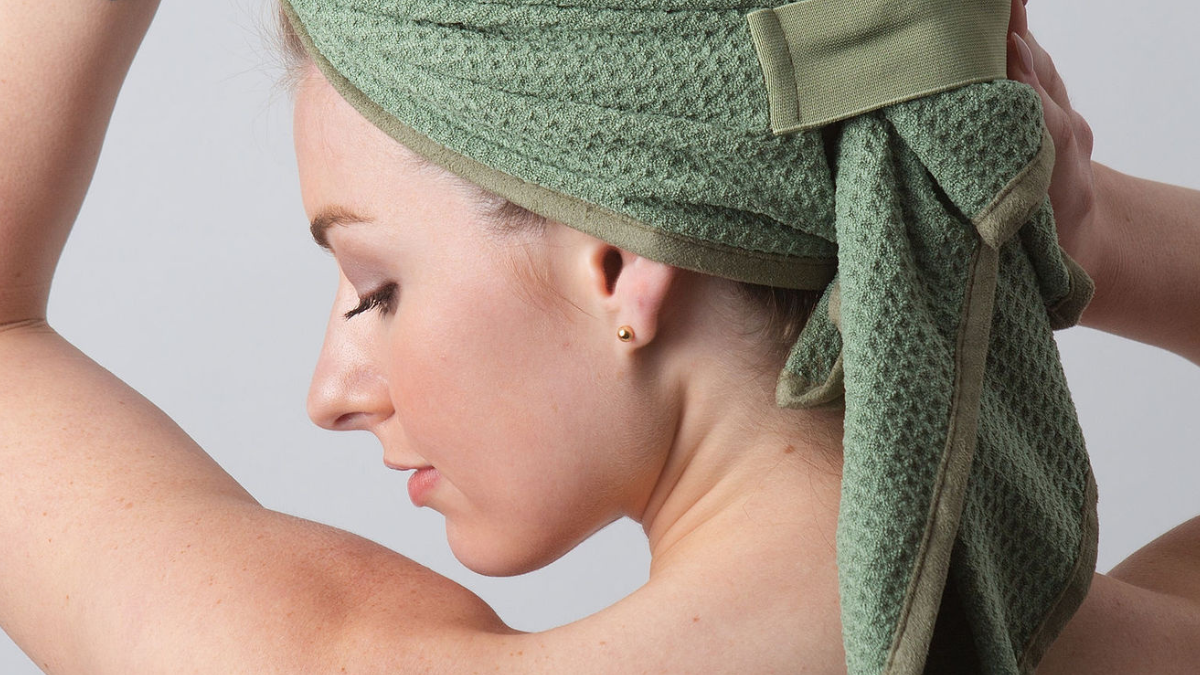
- Bring the bottom of the towel up to wrap around your head, then twist or tuck the sides securely.
- Leave in place for 15–30 minutes. Adjust timing based on your curl type and hair density. Looser waves may need less time, tighter coils may want more.
- Remove the towel by unwrapping gently. Your curls should be significantly less wet and beginning to form with definition.
The benefit of plopping with microfiber specifically: the smooth surface doesn't rough up the cuticle during the wrap time, and the capillary absorption removes water from all sides of the curl simultaneously rather than through directional rubbing.
After Plopping: How to Finish Drying
After plopping, you have a few options depending on your preferred routine:
Air dry. If time allows, this is the lowest-impact option for curls. Leave product in place and let curls dry naturally.
Diffuse. A diffuser attachment on a blow dryer distributes heat evenly without direct airflow, which minimizes frizz. Use low heat and low speed, move the diffuser slowly upward toward the scalp, and finish with a cool shot.
Scrunch out the crunch (SOTC). Many curl-defining products create a cast as they dry, giving the curl a harder feel. Once completely dry, gently scrunch from ends upward to break the cast and release soft, defined curls.
A Note on Product Timing
The most common mistake in curly hair routines isn't the products, it's when they're applied. Curly hair responds best to products applied while hair is very wet. Apply leave-in conditioner and curl cream to soaking-wet or near-soaking hair before the microfiber towel touches it. The towel then removes water while the products remain in place, distributed evenly through the curl.
If you apply product after towel drying, you're applying to hair that has already had its curl formation disrupted. You're working against the process rather than with it.
Finding Your Routine
Curly hair is not monolithic. Wavy hair (2A-2C), curly hair (3A-3C), and coily hair (4A-4C) all respond differently to drying methods and timing. The principles hold across types. Reduce friction, minimize disruption, give the curl room to form, but the timing and products will vary.
What doesn't vary: the material you use matters. Microfiber is consistently the lowest-friction option for curly hair, and lower friction is consistently the better condition for curl definition.
GWEN Hair Towel
The GWEN Hair Towel is a professional-grade microfiber hair towel made in Korea, sized at 30x35in for a full, secure wrap that works for all hair types and lengths. The soft suede-woven edge finishes every detail without a rough seam that could snag delicate curls.
Available in Ivory, Linen, Sage, and Moss.
Your hair, covered.