
Article: You Spend $2.86 Per Wash on Hair Products. Here's the $0.18 Addition That Makes All of It Work Better.
You Spend $2.86 Per Wash on Hair Products. Here's the $0.18 Addition That Makes All of It Work Better.
Before you do anything else in your hair care routine, there's one number worth knowing: the average American spends $372 per year on hair care products alone. Shampoo, conditioner, leave-in treatments, serums, oils. Month after month, it adds up.
Divided across roughly 130 washes a year, the math on 2 to 3 washes per week, that's about $2.86 in product investment every single time you step into the shower.
Most people have never thought about it this way. But once you do, a different question emerges: what are you doing to make that $2.86 actually work?
The Annual Hair Care Picture
For context on what women actually spend on their hair each year:
- Hair care products (shampoo, conditioner, treatments, styling): ~$372/year, or $31/month (Advanced Dermatology America's Beauty Budgets Study, 2024)
- Haircuts: ~$286/year (same study)
- Hair color and highlights: $100 to $300+ per appointment, typically every 6 to 8 weeks for women who color
For a woman who colors her hair (and many women in the 35-55 age range do) total annual hair spending easily clears $1,200 to $1,500, and often more.
That's not frivolous. That's investment in something that affects how you look and feel every day.
The Problem: There's a Step Before All of This
Every product in a hair routine is designed to do something specific: hydrate, smooth, protect, strengthen, define. Each one works at the hair shaft level, and each one depends on one thing being true: that the hair it's applied to is in a receptive, intact condition.
Here's where most routines quietly lose money.
When you dry your hair with a cotton terry cloth towel (the kind hanging in most bathrooms) the rough looped surface creates friction against wet hair. And wet hair is the most vulnerable state. The cuticle is open. The shaft is swollen and elastic. The mechanical abrasion of terry cloth against that open cuticle disrupts the very surface that your leave-in conditioner, your serum, your treatment are about to try to protect.
You apply $0.50 of leave-in conditioner to hair that's been roughed up. It absorbs unevenly. The result is less than what the product is capable of.
Repeat 130 times a year, and the compounding effect is real.
The Microfiber Difference... And What It Costs
Microfiber doesn't work the same way as cotton. Instead of abrading the hair surface to encourage water out, microfiber draws moisture through capillary action. The fiber construction pulls water away without directional friction. The cuticle is left significantly more intact when the towel comes off.
What does that cost?
GWEN Hair Towel |
Cost |
| Purchase Price | $48 |
| Lifespan (conservative) | 2 years (with proper care) |
| Estimated Uses (2.5 washes/wk x 2yrs) |
~260 uses |
| Cost Per Use |
~$0.18 |
| Annualized Cost |
~$24/year |
| As a % of Annual Product Spend |
~6.5% of $372 |
At $0.18 per use, GWEN is the least expensive item in your post-shower stack. It costs less per wash than a single pump of most serums.
The Real ROI: Protecting What You're Already Spending
The case for a microfiber hair towel isn't just that it's inexpensive per use. It's that it changes the performance of everything else you're spending money on.
Your leave-in conditioner is designed to penetrate the hair shaft and seal moisture in. It works best when the cuticle is still somewhat open from washing, not when it's been roughed up and made uneven by friction. When you switch to microfiber, you're applying that conditioner to hair in a better starting state. The product does more of what it's supposed to do.
Your anti-frizz serum works by coating the cuticle to create a barrier against humidity. A disrupted cuticle with lifted, uneven scales gives that serum an inconsistent surface to work on. An intact cuticle gives it something flat to coat uniformly.
If you color your hair, the math is even more compelling. Color-treated hair is more porous than virgin hair. The chemical process opens the cuticle to deposit pigment, and the cuticle never fully recovers its original integrity. Every time you rub a rough terry cloth towel through color-treated hair, you're accelerating pigment loss from an already-vulnerable surface.
Putting It All Together
Here's a simple way to think about it:
- You spend ~$372/year on hair products; $2.86 per wash.
- Each of those products is designed to work on healthy, intact hair.
- A GWEN microfiber towel costs ~$0.18 per wash to add to that stack.
- Used every wash, it's the step that determines whether the rest of your routine lands on smooth hair or roughed-up hair.
- Annualized, GWEN costs $24; about 6.5% of your product budget.
That 6.5% is doing the work that makes the other 93.5% count.
Or looked at from the other direction: if you're investing $1,200 to $1,500 per year between products, cuts, and color, the tool that protects all of it costs less than 2% of that total.
What to Look for When Buying
Not all microfiber hair towels are the same quality or construction. The ones that perform best for hair, rather than general household use, share a few specific characteristics:
- A high-grade polyester/nylon fiber blend: nylon adds softness and durability, and a fine-filament weave is what creates the capillary action that removes water without friction
- Professional-grade weight: substantial enough to absorb effectively without being heavy or stiff on your head
- Full-size coverage: a 75x90cm towel wraps all hair types and lengths properly and stays in place
- Proper care instructions followed: no fabric softener (which fills in the microfiber channels and kills absorbency), hand wash, line dry
GWEN Hair Towel
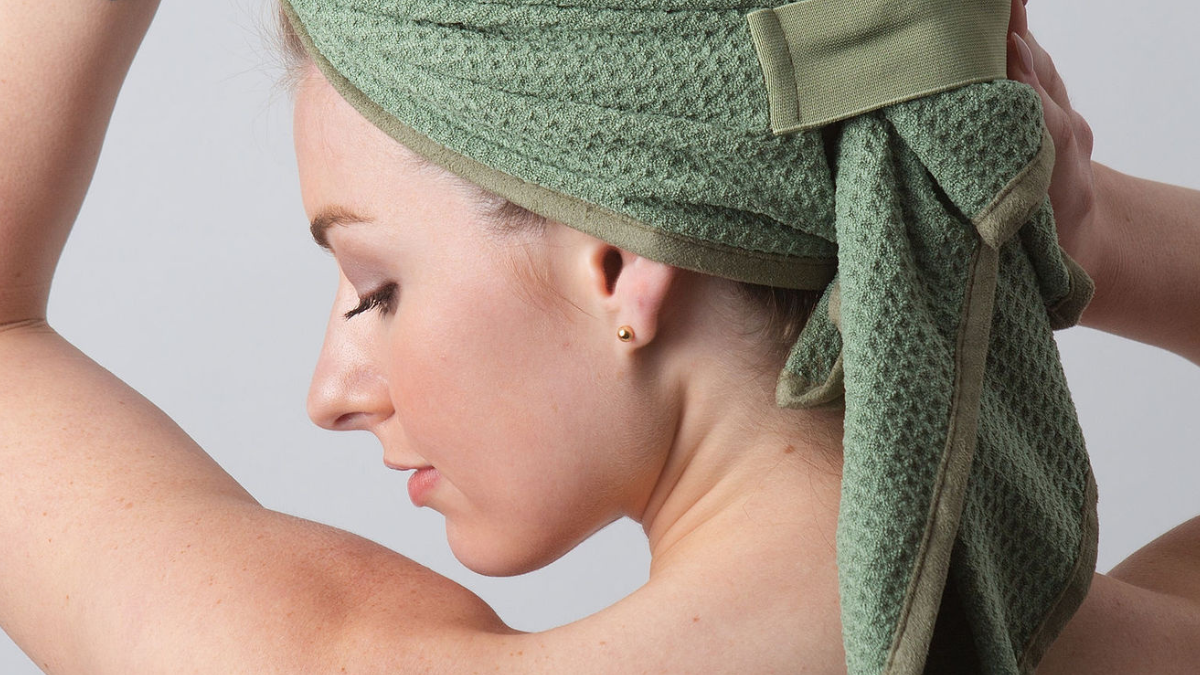
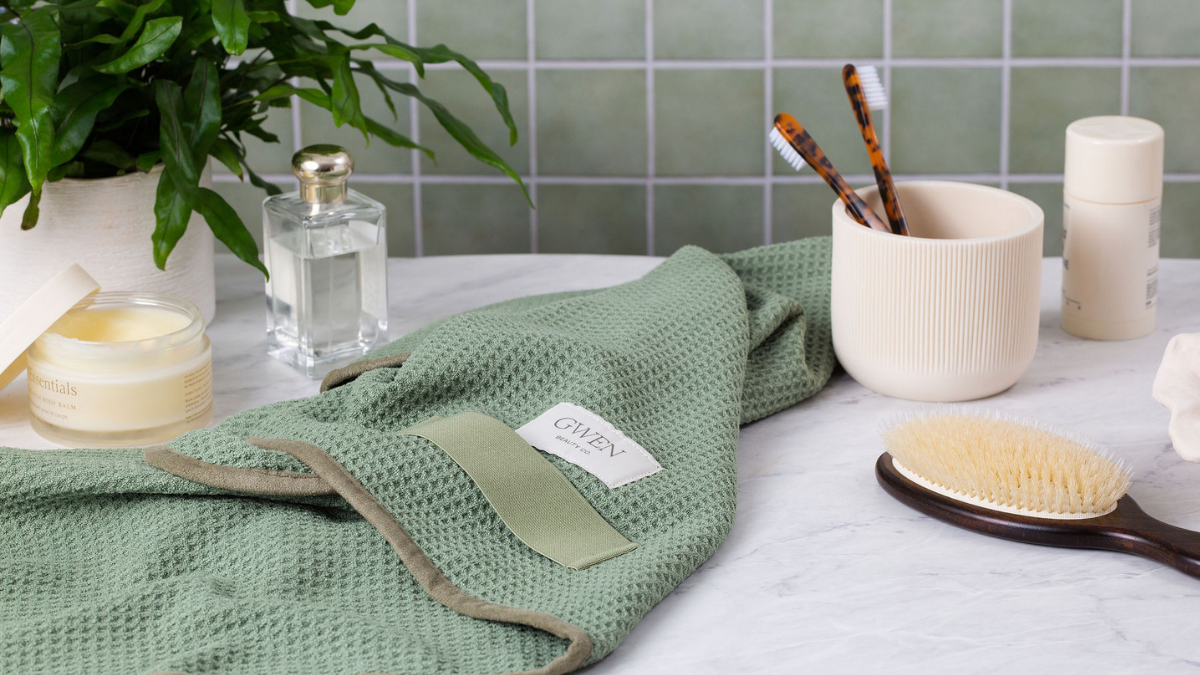
The GWEN Hair Towel is a professional-grade microfiber hair towel made in Korea, designed to give your hair the gentlest possible start after every shower. It measures 30x35in for a full, secure wrap, and its soft suede-woven edge finishes every detail at the same level as the towel itself.
Available in Ivory, Linen, Sage, and Moss.
Your hair, covered.